|
The
Puerto Rico Constitution establishes a democratic and republican
form of government, divided into three branches: the legislative,
executive, and judicial branches, each of equal importance and equally
subordinated to the sovereign power of the people.
The legislative branch consists of a bicameral Legislative Assembly
with a Senate (27 members) and a House of Representatives (51 members).
A constitutional provision requires the total membership in the
assembly be expanded, if necessary, to increase minority representation
whenever one party controls more than two-thirds of the seats.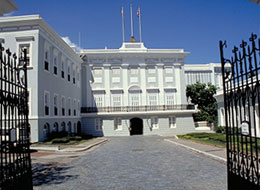
A resident commissioner, who serves as the island's sole delegate
to the U.S. Congress, holds limited powers as a member of the U.S.
House of Representatives. Executive authority is vested in a governor.
The island is divided into 78 municipalities, each administered
by a mayor and municipal assembly. All of the aforementioned positions
are elective, with balloting conducted on the Tuesday after the
first Monday in November, in years divisible by four; with victorious
candidates taking office the following January. Resident U.S. citizens,
age 18 and older, are eligible to vote; voter turnout consistently
exceeds 80% of the electorate.
The governor holds nomination power over executive branch and public
corporation leadership positions, under a highly centralized structure.
The secretary of state (who serves as acting governor in the chief
executive's absence) must be confirmed by a majority vote of both
chambers of the Legislative Assembly; other senior nominees require
confirmation only by the Senate.
The constitution vests judicial power in the Puerto Rico Supreme
Court, and such lower courts as may be established by law. Members
of the judicial branch are nominated by the governor and confirmed
by the Senate. Decisions rendered by municipal, district, and superior
courts may be appealed, until they reach the Commonwealth Supreme
Court composed of seven justices. Lower-court judges serve fixed
terms; Supreme Court justices serve until retirement. The court
system is administered by the chief justice of the Supreme Court.
Seven judges, nominated by the U.S. president and confirmed by the
stateside Senate, serve on Puerto Rico's federal district court.
Its decisions may be appealed through the federal court system to
the U.S. Court of Appeals for the First Circuit, and on to the U.S.
Supreme Court. Decisions of the Puerto Rico Supreme Court may be
appealed directly to the U.S. Supreme Court.
The Government Development Bank (GDB), the government's fiscal agent,
zealously guards the investment-grade quality of Puerto Rico's bonds,
observes applicable government debt limits, and follows the bond
market's high demand of the island's long-term obligations with
institutional bond buyers. By law, the government must balance its
budget.
The GDB also finances various capital and infrastructure improvements
for the central government, its agencies and dependencies, and its
public corporations. It also helps finance private economic development
projects. Afica (the Spanish acronym for the Puerto Rico Industrial,
Tourism, Educational, Medical & Environmental Control Facilities
Financing Authority)Ña GDB subsidiaryÑprovides long-term (bond)
financing for multimillion-dollar hotels, office buildings, and
other projects.
The Economic Development Bank, an adjunct of the GDB, helps finance
smaller projects with loans, guarantees, or equity.
The Puerto Rico Industrial Development Co. (Pridco, formerly known
as Fomento), promotes Puerto Rico as an ideal industrial site by
facilitating local tax exemption under the local Tax Incentives
Law and assisting industrial investors through required permit processes.
Pridco also leases government-owned factory buildings at preferential
rates and otherwise helps investors establish operations on the
island.
The question of political status continues to dominate the political
arena.
For the past 50 years, two main parties, each favoring a different
political status, have waged passionate campaigns for power in which
Puerto Rico's future identity has been a key issue. The Popular
Democratic Party (PDP), currently in office, favors enhancement
of the existing territorial relationship with the U.S. under the
name "Commonwealth." The New Progressive Party (NPP), most recently
in office from , advocates statehood within the Union.
The much smaller (4%) Puerto Rican Independence Party (PIP) favors
an independent republic.
Political parties in Puerto Rico primarily are driven by status
preferences, not by socioeconomic action plans or ideological platforms
on how to run the island. The NPP maintains strong affiliations
with the States' Republican and Democratic national parties, whereas
the PDP is more affiliated with the U.S. Democratic Party.
|